 Robert Russell Designs
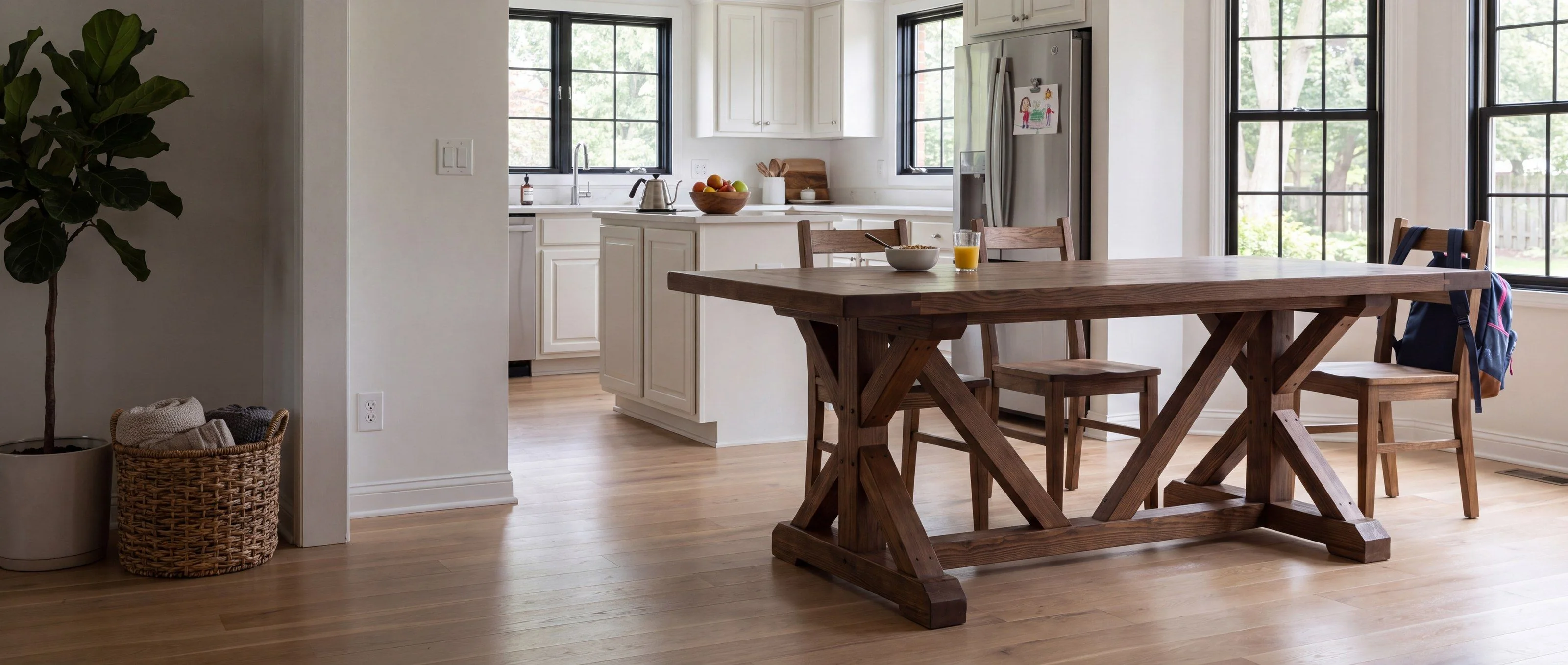
Shown in a rendered room
What base or leg style works for a 10 foot dining table?
A trestle or a twin pedestal, both set in from the ends. At 96 inches and longer the base has two jobs that fight each other: carry the span, and stay out of the way of ten to twelve chairs. Support set in from each end does both. Four corner legs do neither well, because they claim the end seats and leave the middle of the span unsupported.
The rule that decides it
Sit at the table before you choose the base.
Every seat along the side needs 24 inches of edge and clear floor for the chair. Every seat at the end needs knee room under an overhang. A base member that lands in either of those places will be discovered on the first night the table is full, and it cannot be moved afterwards.
So the question is not which base looks best in a photograph. It is where the support can land without taking a seat, and at length there are really only two answers: inboard of the ends, or fully outboard at the corners where nobody sits.
The options at length
Trestle. Two uprights set in from the ends, joined by a stretcher down the center. The oldest answer to a long table and still the best one: the load is carried where it matters, the sides are completely clear, and the overhang past each trestle is what makes the end seats comfortable. The stretcher is the one thing to check, since a low center stretcher can meet the feet of whoever sits in the middle. See the Regal trestle and the arc trestle for two versions of the same idea.
X-base. A trestle geometrically, with the uprights splayed into an X. Same structural behavior, a wider footprint at the floor, and more visual movement under the top. The wider foot is worth measuring against the chairs, because it reaches further toward the seating positions than a vertical trestle does. The X-based tables show the range.
Splayed legs. Four legs, angled out. Visually light, mid-century in character, and better suited to tables under about 96 inches. At length the splay pushes the feet outward into exactly the floor space the end chairs want. The splayed leg collection is where this reads best, on shorter pieces.
Twin pedestal. Two sculptural bases inboard of the ends. Structurally the same logic as a trestle with the stretcher removed or hidden, so it clears the center completely. It is the most forgiving base for a table that will regularly seat people at both ends. See open loop pedestals and modern open loop.
Steel. Any of the above in metal rather than wood. Steel reaches the same strength in a much smaller section, so a long top can sit on something visually slight without sagging, and the contrast with a thick slab is part of the appeal. The detail that matters is the attachment: a steel base will not move and a wood top will, so the top has to be fixed in a way that lets it. Metal-based tables cover the range.
Quick comparison
| Base | Clear sides | Clear ends | Best at |
|---|---|---|---|
| Trestle | Yes | Yes, past the overhang | Any length, strongest at 96 in and up |
| X-base | Yes | Check the foot | 84 to 132 in |
| Splayed legs | Mostly | No | Under 96 in |
| Twin pedestal | Yes | Yes | Long tables that seat the ends |
| Steel | Depends on design | Depends on design | Thick tops, slender look |
Getting it right the first time
The base is the part of a table that is hardest to change later and easiest to get wrong on paper, because the conflict only appears when the chairs are pulled out.
Work out the size first, using the sizing guide, then place the seats, then choose the base that stays clear of them. On a commissioned piece that sequence is the normal one: the drawing shows the base in the room with the chairs where they will actually go, before anything is cut.
By Rob Showalter, furniture maker in Geneva, Illinois.
Related questions
- What base is best for a 10 foot dining table?
- A trestle or twin pedestal base, set in from each end. Both put the support where the top needs it and leave the corners and the middle of each side completely clear for chairs.
- Can a long table have four corner legs?
- It can, and the compromise is seating. A leg at each corner takes the two best end-adjacent seats out of play and gives the top no support in the middle, which is the part of a long span that needs it most.
- How far in from the end should a trestle sit?
- Far enough that someone seated at the head has clear knee room, which usually means the trestle sits inboard of the end by more than the depth of a place setting. The overhang beyond it is what makes end seating work.
- Does a steel base work under a long wood top?
- Yes, and it is often the cleanest answer at length, because steel gets the strength from a smaller section. The thing to check is that the top can still move seasonally against a base that will not.
Next
- Regal trestle table handcrafted in solid wood
- X-Based Trestle Tables
- Custom Metal Base Tables
- Begin a commission
Last reviewed September 21, 2026