 Robert Russell Designs
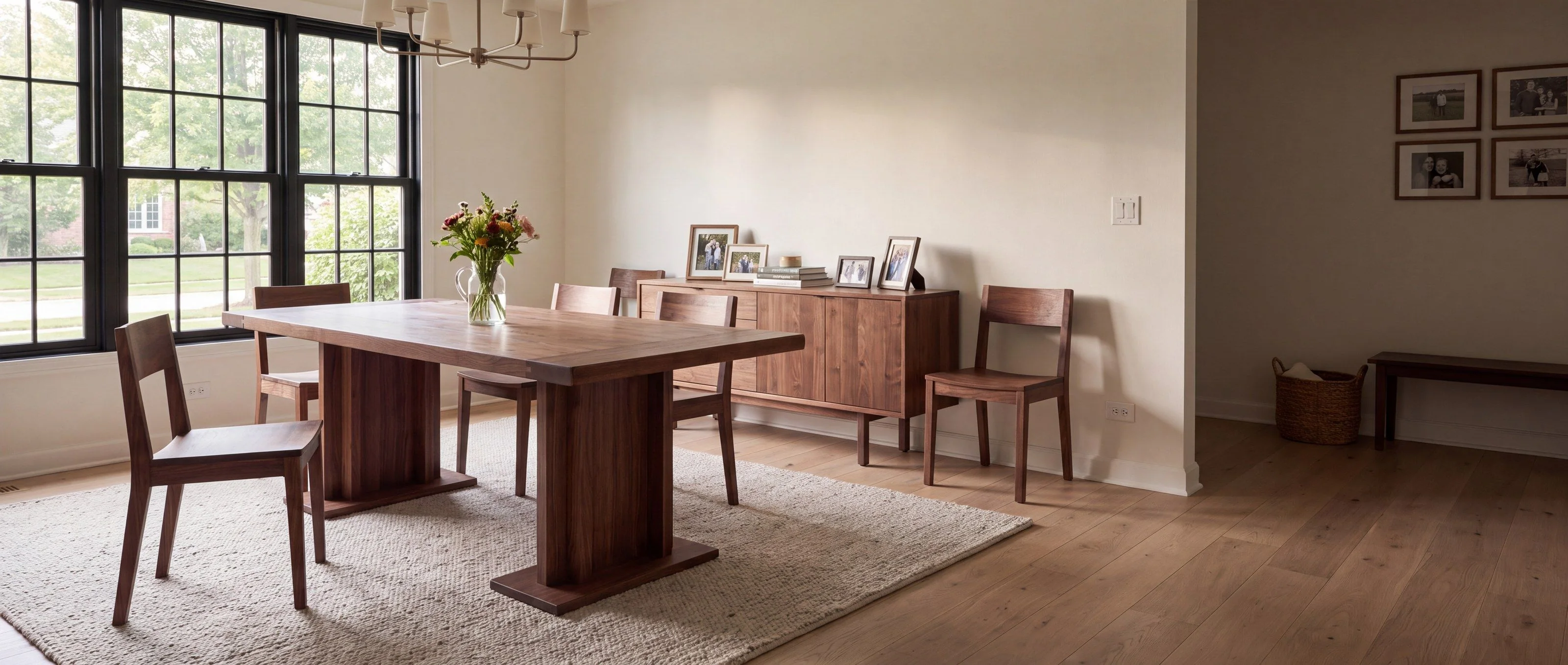
Shown in a rendered room
Answers
The questions people ask before commissioning custom furniture or a table
Sizing, thickness, species, movement, construction, bases. Each page answers one question in the first paragraph and then explains it. If the question you have is not here, ask me; it is a good place to begin a commission.
Buying a Custom Table
-
Can someone build a dining table to my exact room dimensions?
Yes. On a commissioned piece the size is an input, not a choice from a list: a 116 inch table is no harder to build than a 120 inch one. What to measure, what actually constrains the size, and what happens before anything is cut.
-
How long does a custom dining table take?
6 to 12 weeks from design approval. When the clock starts, why a one-off table takes the time it takes, and when a faster timeline may be possible.
-
How much does a custom dining table cost?
Most of my commissions, dining tables included, fall between $6,000 and $20,000. What moves a table within that range, and how to get a rough price on the first call.
-
What deposit is required, and what happens if I cancel?
A 40 percent deposit of the initial approved project price books the commission, with 5 business days to cancel. After that, the deposit is non-refundable because production time has been reserved and work on the commission may already be underway.
-
Who makes custom dining tables in the Chicago area?
Robert Russell Designs builds one-off hardwood and epoxy dining tables in Geneva, Illinois, and generally delivers and installs them personally across Chicagoland. What working with a local maker changes, and what it does not.
-
Why buy handmade furniture instead of mass produced?
A commissioned piece is built for one room, to dimensions you set, from boards chosen for your table. A factory piece is designed for the widest possible market. What that difference actually buys, and what it costs you.
Design & Style
-
How thick should a dining table top be?
1.25 to 2 inches for most solid-hardwood dining tables. What thickness does structurally, what it does visually, and the knee clearance it quietly eats.
-
What base or leg style works for a 10 foot dining table?
At 96 inches and up the base stops being decoration. Trestle, X-base, splayed leg, twin pedestal and steel, compared on the only thing that matters at length: where the support lands relative to the chairs.
-
What size dining table do I need for my room?
Measure the room, subtract 36 inches of clearance on every side, and the rest is your table. Seat counts by length, the width that actually works, and what to do when the room sits between standard sizes.
-
Who makes a 10 to 12 foot dining table for a large family?
A 120 inch table typically seats ten and a 144 inch table typically seats twelve. At that length three things change: how the top has to be built, which bases still work, and whether the piece can get into the room.
Materials & Wood
-
Walnut or white oak for a dining table?
White oak is harder; black walnut generally moves less at comparable grain direction. How the species differ in movement, color and cost for a dining table.
-
What is the difference between a single slab, a bookmatched and a multi-board table top?
Three ways to make a table top out of one tree or several. What each one takes to source, how each behaves over time, and how each method changes the look and character of the finished piece.
-
Will a solid wood dining table crack or cup in a dry house?
Proper drying and a top attached to allow movement reduce the risk of cracking or cupping. How construction and the conditions in your room affect solid wood.
Finishes & Care
-
Can a furniture maker match the finish or color I already have?
Yes, closely, with physical samples. What to send, how the samples are developed, and why matching a finish is different from choosing a room's palette.
Send your room dimensions and how many people you seat, and the answer comes back specific to your room rather than general.