 Robert Russell Designs
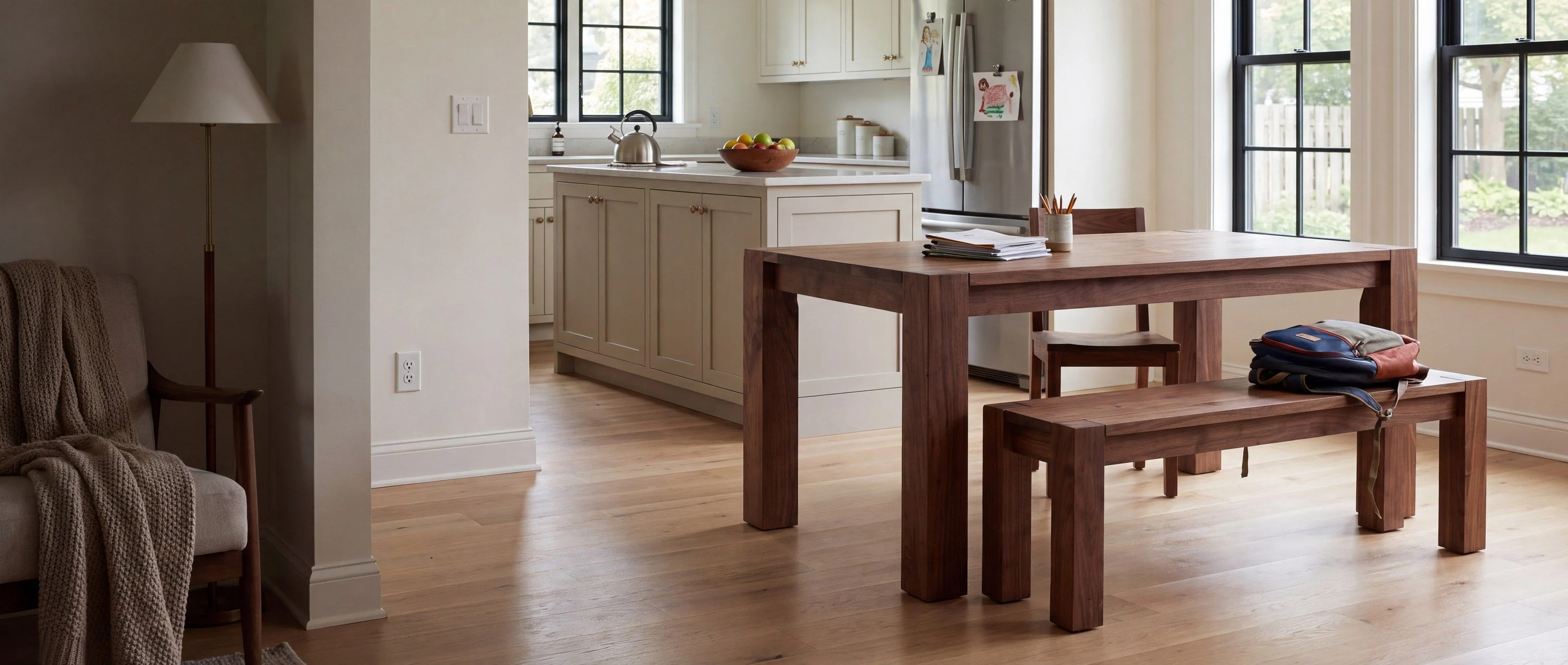
Shown in a rendered room
Will a solid wood dining table crack or cup in a dry house?
Good construction reduces the risk, but solid wood can still crack or cup. The top needs to be dried for indoor use and attached so it can expand and contract. After delivery, the conditions in your room matter too. Very dry air or sharp changes in humidity can stress a table even when it was built well.
What wood movement actually is
Wood gives up and takes on moisture until it matches the air around it. As it does, it changes dimension across the grain. Along its length it barely moves at all.
For a 44 inch wide hardwood top, the seasonal swing between a humid summer and a dry heated winter is typically somewhere around a quarter to a half inch across the width, depending on species and cut. That movement is not a defect and it cannot be prevented. It can only be allowed for.
The construction has to allow for that movement. The conditions in the room help determine how much movement there is.
Common causes of cracking and cupping
1. The wood was not dry enough when it was built. Slabs for indoor furniture are dried to roughly 6 to 8 percent moisture content, and thick slabs take a long time to get there. A slab that was surfaced and built while still wet in the middle will keep drying in your dining room and the stress has to go somewhere.
2. The top was fastened down rigidly. If a top is glued or screwed tight to an apron or a base that will not let it move, the wood still moves. It just has to tear itself to do it. Tops should be attached with something that slides: elongated slots, z-clips, figure-8 fasteners, a breadboard end pinned only at the center.
3. The top is exposed unevenly. A radiator, floor vent or patch of direct afternoon sun can change the moisture conditions on one part of the table faster than another. Uneven moisture, grain direction and stresses left from drying can all contribute to cupping. Finishing both faces helps slow moisture exchange, but it does not stop it. Keep the table away from concentrated heat and prolonged direct sun.
What you can control once it is in the room
Keep the conditions reasonably steady:
- Keep the house somewhere between 35 and 50 percent relative humidity, and care more about the swing than the number.
- Keep the table out of direct sun and off the line of a heating vent.
- Wipe spills rather than leaving them, and do not leave a wet dish sitting.
- Follow the finish. An oiled top and a conversion varnish top want completely different maintenance, which is covered in the finish-specific care guide.
Questions worth asking before you commission
Any maker should be able to answer these without hesitating:
- What moisture content was the slab at when you surfaced it, and how did you measure it?
- How is the top attached to the base, and how much movement does that allow?
- Is the underside finished the same as the top?
The answers tell you most of what you need to know about whether a five figure table is going to behave. If you want to see how the piece gets from a slab to a delivered table, that is the process.
By Rob Showalter, furniture maker in Geneva, Illinois.
Related questions
- Will a solid wood dining table crack in a dry house?
- Proper drying and an attachment that lets the top expand and contract reduce the risk. They cannot guarantee that wood will never crack or cup: very dry conditions, sharp humidity changes and uneven exposure to heat or moisture can still cause problems.
- What humidity should I keep the room at?
- Somewhere between 35 and 50 percent relative humidity, and more importantly, without violent swings. A house that runs 45 percent all year is easier on a table than one that alternates between 20 and 60.
- Why do table tops cup?
- Cupping can happen when the two faces gain or lose moisture unevenly. Grain direction and drying stresses also matter. Keeping the table away from direct sun and heat sources helps reduce uneven exposure.
- Does an epoxy river table move the same way?
- The wood in it does, and the resin does not, which is why the joint between them is the place to look. It makes correct drying and a base that allows movement more important, not less.
Next
- Caring for Your Custom Wood & Epoxy Table: Expert Finish-Specific Care Tips from Robert Russell Designs
- Walnut or white oak for a dining table?
- The Process
- Begin a commission
Last reviewed October 4, 2026