 Robert Russell Designs
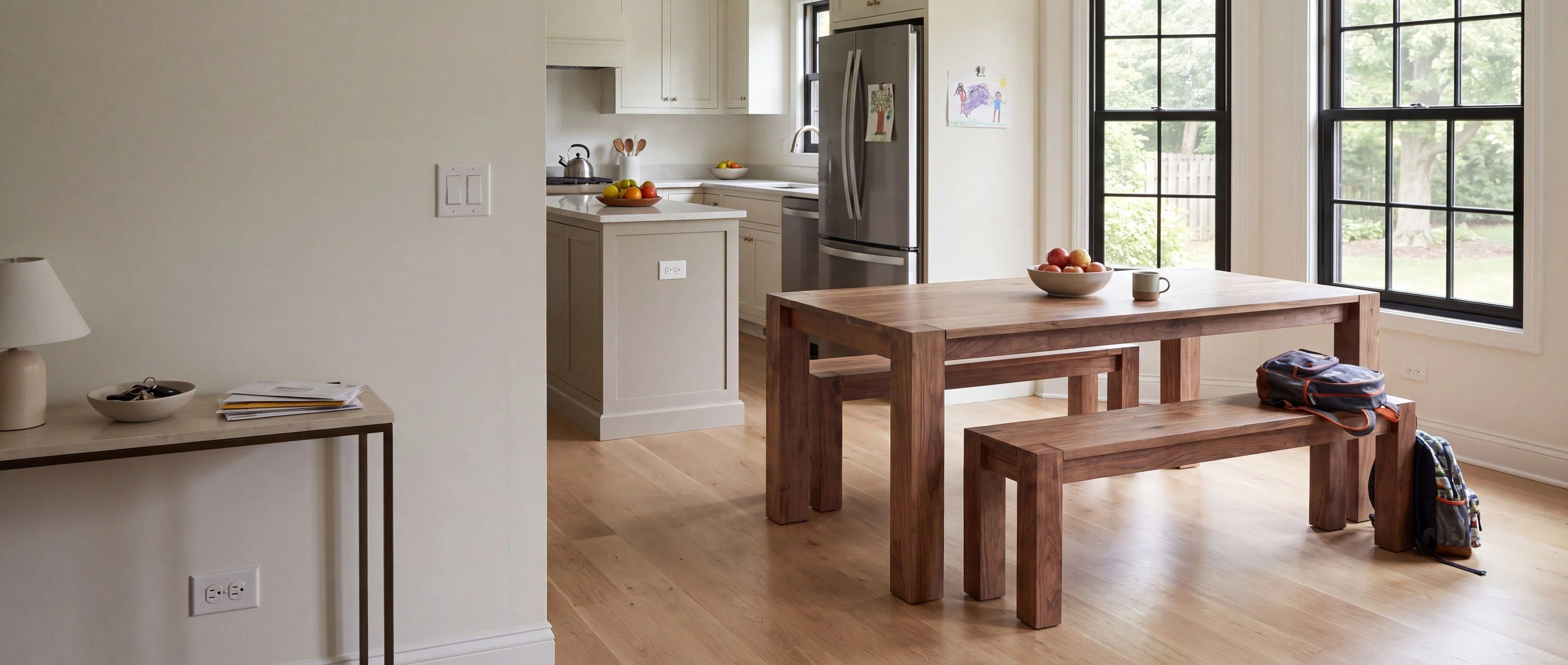
Shown in a rendered room
Walnut or white oak for a dining table?
White oak is harder, measuring about 1,360 on the Janka scale against roughly 1,010 for black walnut. With comparable grain direction, black walnut generally moves less as humidity changes. Walnut is also darker and mellows toward honey with age. Both work well for dining tables; the cut of the boards and the way the top is attached matter alongside the species.
The short comparison
| Black walnut | White oak | |
|---|---|---|
| Janka hardness | ~1,010 | ~1,360 |
| Color, new | Chocolate with grey and purple tones | Pale tan to light brown |
| Color, in ten years | Lighter, warmer, honey | Deeper, ambered |
| Grain | Calmer, often figured | Strong, open ray fleck when quartersawn |
| Movement, comparable grain direction | Generally lower | Generally higher; quartersawn moves less than flatsawn |
| Wide slabs | Widely available | Available, less common at full width |
| Typical cost | Lower for the same size | Higher for the same size |
Hardness matters less than people expect
The Janka difference is real and it is not the thing that will decide whether you like the table in five years.
Dining tables are not floors. The damage a dining top takes is scratching from things dragged across it, ring marks from moisture, and the occasional impact, and the finish handles far more of that than the species does. A hard wood under a poor finish dents through the finish. A softer wood under a good finish lives a normal life.
What hardness does change is the character of the wear. Walnut takes a dent more readily and the dent reads as patina. Oak resists the dent and, when it finally takes one, shows it more sharply.
Movement is the one worth paying attention to
Every solid top expands and contracts across its width as humidity changes through the year. Compare boards cut the same way and black walnut generally moves less than white oak. Change the cut and the comparison can change too: a quartersawn white oak board can move less across its width than flatsawn walnut.
Oklahoma State University’s wood-movement reference compares the species and grain directions. Its figures describe shrinkage from green to oven dry, not the seasonal change to expect in a finished table. They show why hardness and resistance to movement are separate questions.
In a house that runs dry in winter and humid in summer, that difference shows up as how much the top grows and shrinks, and how much stress it puts on the base. It is not a reason to avoid walnut. It is a reason to ask how the top is attached, which matters more than the species either way. That is covered in will a solid wood table crack or cup.
Color, and the mistake people make
New walnut and ten year old walnut are different colors, and most people choose from a sample of the first one.
Walnut lightens with light exposure. The cool purple and grey cast in a fresh board warms and softens, and the table you have in a decade is browner and friendlier than the one delivered. White oak goes the other way, ambering and deepening, which is worth knowing if the room has a lot of daylight and pale furniture that will not move with it.
Neither is a problem. Both are a reason to look at a finished piece with some age on it rather than at a raw sample.
Which one for which room
Walnut suits rooms that can carry a dark mass: good natural light, pale walls, or a room already anchored by something heavy. In a small dark dining room a large walnut top can close the space down.
White oak suits rooms that need the furniture to stay quiet, and it takes a wider range of finishes convincingly, from near-white to fumed and dark. Quartersawn oak brings its own strong ray-fleck pattern, so “quiet” depends on the cut.
If you already know you want walnut, the walnut collection is the place to start. If you are weighing species more broadly, the comparison of walnut, elm and maple covers the other common choices for an epoxy top.
By Rob Showalter, furniture maker in Geneva, Illinois.
Related questions
- Is white oak harder than walnut?
- Yes. White oak measures about 1,360 on the Janka hardness scale against roughly 1,010 for black walnut, so oak resists denting better. Both are well inside the range used for dining tables.
- Which is more stable, walnut or white oak?
- With comparable grain direction, black walnut generally moves less across its width than white oak. Quartersawn white oak can move less than flatsawn walnut, so the cut matters as much as the species comparison.
- Does walnut fade over time?
- Walnut lightens. The purple and grey tones in new walnut mellow toward a warmer honey brown over several years of light exposure, and the effect is usually considered an improvement. White oak moves the other way and ambers.
- Which is better for an epoxy river table?
- Walnut is the more common choice because the dark background makes a translucent resin river read clearly. White oak works, but the contrast is softer and the pour color has to be chosen with that in mind.
Next
- Walnut Collection
- Walnut vs Elm vs Maple: Best Wood for Custom Epoxy Dining Tables
- Dining Table Collections
- Begin a commission
Last reviewed October 6, 2026