 Robert Russell Designs
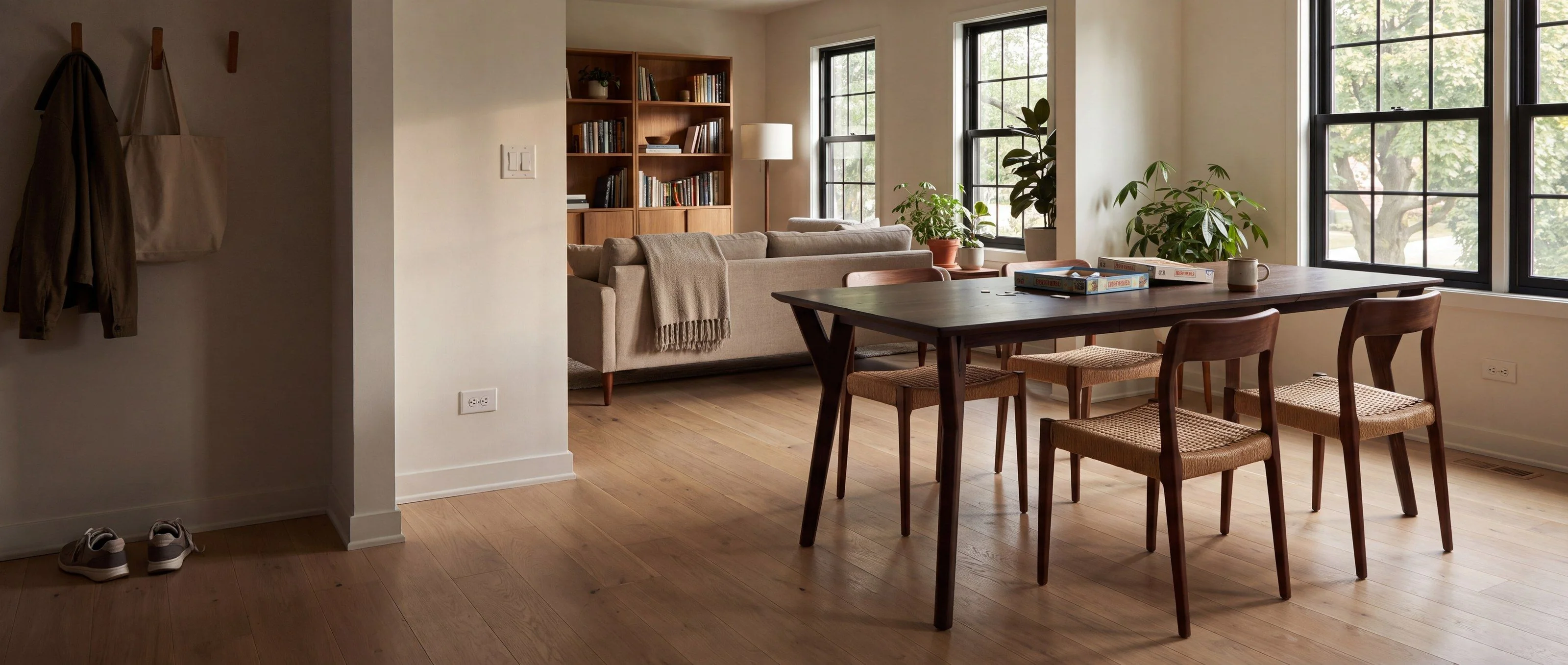
Shown in a rendered room
Why buy handmade furniture instead of mass produced?
Because it is built for one room rather than for every room. A commissioned piece is made to dimensions you set, from boards chosen for your table, by someone you can ask questions. A production piece is designed once for the widest possible market and then built to hit a price. One difference is measurable: a commissioned table is drawn before it is cut, and that drawing is held to 95 to 99 percent of the finished piece.
What you are actually comparing
The comparison people think they are making is quality against price. The one they are actually making is fit against convenience.
A production table exists before you want it. Its size was chosen by a planner working from average rooms, its thickness by what survives flat-pack shipping, its finish by what tolerates a warehouse. All of those decisions were made well, for a buyer who is not you specifically.
A commissioned table does not exist yet, which is the entire point. The length comes from your room, the width from how you eat, the species from the light you have, and the base from where the chairs go. Nothing about it is an average.
What it costs you
Two things, and they should be said plainly.
It costs more. The materials are a part of that, but the real driver is labor: one person spends days on a piece a factory turns out in minutes, and that time is most of the number.
It takes longer. A production table arrives when the truck arrives. A commissioned table has to be designed, the boards found and milled, the joinery cut, the finish built up in coats that have to cure. You are buying a schedule as well as a table.
If neither of those is worth it for the room in question, the honest answer is that the factory table is the right purchase.
What it buys
- Fit. The size is an input rather than a choice from a list, which matters most in rooms that sit between standard sizes. Nearly all of them do.
- The actual boards. On a one-off piece the material is selected, not specified. You are looking at the slab that becomes your top rather than at a photograph of a species.
- A drawing before a cut. You approve the piece as a drawing, a SketchUp model and AI-assisted visualizations of it in a finished space, not as a description. See the process.
- Someone to ask. A question about your table goes to the person who built it. Ten years from now that is still true.
How to tell a maker from a reseller
The word handmade is unregulated and gets used by companies that import and assemble. Three questions separate them, and none of them is rude to ask:
- Who cuts and finishes it, and where?
- Can I see the specific boards before they are milled?
- Will I see a drawing of my piece before anything is cut?
A maker answers all three immediately. A reseller can usually manage the first in general terms and cannot answer the second at all.
For resin tables specifically, the differences run deeper than sourcing, and they are covered in custom epoxy tables vs mass-produced resin tables.
Where to start
Start with the room rather than with the table. Measure it, count the people you seat on an ordinary night, and work out the size the space will actually take using the sizing guide. That number is the beginning of every useful conversation about a commissioned piece, and it is the same number that tells you whether a stock table would have worked after all.
By Rob Showalter, furniture maker in Geneva, Illinois.
Related questions
- Is handmade furniture worth the money?
- It depends on how long you intend to keep it and how particular the room is. For a piece you expect to own for decades, in a space where stock sizes do not fit, a commissioned table answers a problem a factory table cannot. For a first apartment it usually does not.
- How can I tell if furniture is actually handmade?
- Ask who cuts it, ask to see the specific boards before they are milled, and ask whether you will see a drawing of your piece before anything is cut. A maker can answer all three in a sentence. A reseller cannot answer the second one at all.
- Is handmade furniture more expensive than store bought?
- Yes, and the reason is labor rather than materials. One person spends days on a piece a factory produces in minutes, and that time is most of what you are paying for.
- What is the real difference in how it is built?
- A commissioned table is designed around your room and the actual boards on hand. A production table is designed once for the widest possible market, then built to hit a price at volume, which decides the thickness, the joinery and the finish.
Next
- Custom Epoxy Tables vs Mass-Produced Resin Tables
- The Process
- What size dining table do I need for my room?
- Begin a commission
Last reviewed September 22, 2026